Random Number Generators Determine Free Spin Probabilities in Mobile Slot Ecosystems
Written by Ulrich Berger · Oct 18, 2026
Random Number Generators Determine Free Spin Probabilities in Mobile Slot Ecosystems
Random number generators form the core computational layer that sets free spin trigger rates across mobile slot platforms, and developers rely on these algorithms to produce sequences of outcomes that meet regulatory standards for fairness. Each spin pulls a value from a continuous stream of pseudorandom numbers, and specific ranges within that stream map directly to symbol combinations that launch bonus rounds. Mobile ecosystems add layers of complexity because processors, operating systems, and network conditions influence how quickly the RNG cycle refreshes yet the underlying probability mathematics stays identical to land-based counterparts.
Core Mechanics of RNG Implementation in Mobile Slots
Modern mobile slots use cryptographic hash functions or linear congruential generators seeded by device entropy sources such as accelerometer data, touch timestamps, and thermal noise readings, while certification labs test the output distribution against expected statistical models. When a player initiates a spin the client requests a fresh seed block from the server, the server returns an encrypted packet, and the local RNG advances from that point to determine reel stops within milliseconds. Free spin triggers sit at fixed probability thresholds, for instance one in two hundred and forty spins for a three-scatter combination, and these thresholds remain constant regardless of device type because the algorithm enforces them through modular arithmetic rather than hardware variables.
Trigger Rate Calculation and Volatility Profiles
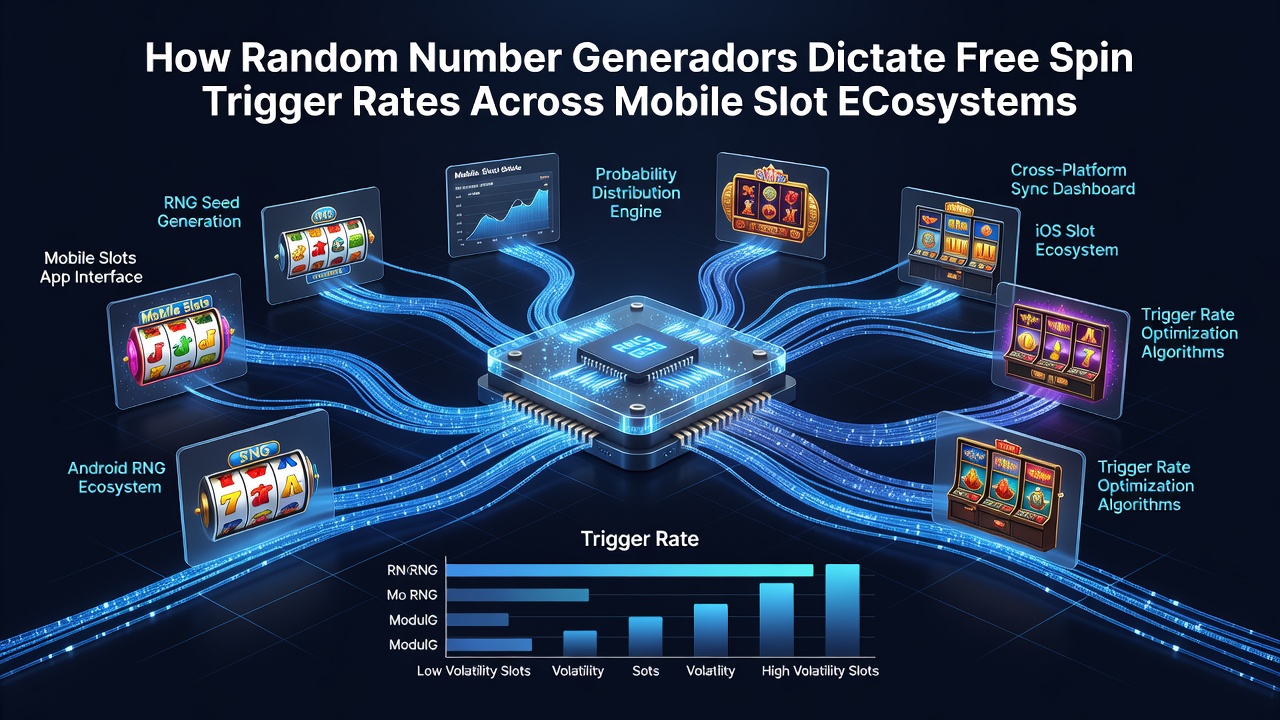
Developers publish return-to-player percentages alongside volatility indices that quantify how often free spin sequences appear, and data from certified testing houses shows that low-volatility titles deliver bonus rounds every eighty to one hundred and twenty spins on average while high-volatility games stretch intervals to four hundred or more. The calculation multiplies the individual symbol probabilities for each reel position and accounts for weighted reels that contain more blank spaces than paying symbols. Mobile operators adjust visual presentation speed without altering these core probabilities, so a rapid reel animation still resolves to the same RNG outcome that a slower desktop version would produce.
Regulatory Testing Standards Across Jurisdictions
Testing laboratories accredited by the Nevada Gaming Control Board and the Malta Gaming Authority run millions of simulated spins to verify that observed free spin frequencies fall within five percent of theoretical values, and reports from these labs feed into license renewals that occur on annual cycles. In October 2026 several European markets plan to introduce updated remote gaming directives that require real-time logging of RNG seed values for audit trails, a change that will let regulators cross-check mobile trigger rates against submitted mathematical models without accessing proprietary source code.
Research from the University of Nevada's gaming management program has examined how network latency affects perceived trigger timing yet found no measurable impact on actual probability because the RNG result locks in at the moment the spin button registers. Operators therefore focus engineering effort on client-side buffering rather than probability tweaks, and players experience consistent free spin intervals whether they connect through 5G or Wi-Fi.
Platform Differences and Cross-Device Consistency
Android and iOS environments handle floating-point arithmetic slightly differently, yet studios compile separate builds that normalize RNG output to identical integer ranges before symbol mapping occurs. This normalization step prevents small rounding discrepancies from shifting free spin frequencies by even a fraction of a percent, and comparative audits across both platforms confirm trigger rates align within statistical tolerance. Independent test houses publish quarterly summaries that aggregate millions of spins from live operators, and these summaries demonstrate that mobile titles maintain the same bonus activation curves as their desktop counterparts despite differences in screen resolution and input methods.
Future Developments in RNG Transparency
Industry groups such as the Remote Gambling Association have begun publishing guidelines that encourage operators to disclose the mathematical basis for free spin frequencies in player-facing help menus, and several major studios already embed simplified probability tables inside game information screens. These tables list the exact combination counts required for each bonus type without revealing the full RNG algorithm, giving players clearer expectations while preserving proprietary methods. As mobile data speeds increase, developers explore server-side RNG streaming that could reduce client computation load further, yet the fundamental relationship between random sequences and free spin triggers will continue to rest on verified probability models.
Conclusion
Random number generators establish fixed probabilities that govern every free spin activation across mobile slot ecosystems, and regulatory frameworks plus technical standardization ensure those probabilities remain consistent regardless of device or connection type. Ongoing updates scheduled for 2026 will strengthen audit capabilities without changing the underlying mathematics that players encounter each time they tap the spin button.